
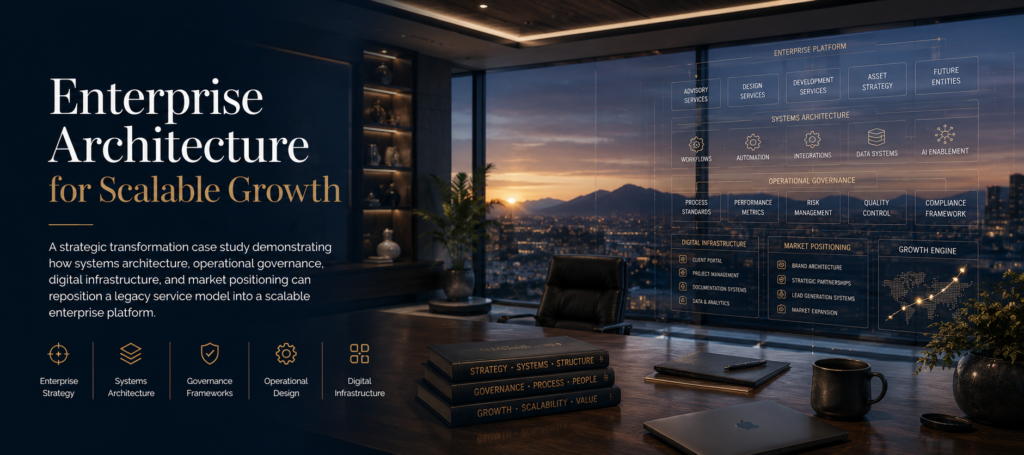
From Fragmented Growth to Scalable Enterprise Infrastructure
This case study illustrates how strategy, systems architecture, operational governance, digital infrastructure, and market positioning can be integrated into a unified enterprise model designed for controlled growth, stronger execution, and long-term platform value.
From Service Delivery to Enterprise Infrastructure
This case study examines the strategic repositioning of a high-performing boutique service model into a scalable enterprise platform designed to support advisory services, interior architecture, asset development, partnership ecosystems, and future vertical expansion.
The transformation required more than brand refinement. It required operational architecture, digital infrastructure, market repositioning, governance logic, and process systems capable of supporting growth beyond a single-service business model.
The result is an active enterprise buildout structured around scalability, controlled growth, and long-term asset value—demonstrating how strategy, systems, and governance can convert fragmented operations into a more durable business platform.
Transformation Drivers
Five Layers of Enterprise Transformation
The transformation was structured across five integrated layers designed to align strategy, systems, positioning, digital infrastructure, and governance into a scalable operating model.
Strategic Positioning
Reframed the firm from a service provider into an asset-focused enterprise platform with broader advisory and development relevance.
Systems Architecture
Designed workflows, intake pathways, partner systems, vendor databases, and internal process logic for repeatable execution.
Digital Infrastructure
Built platform architecture across website, portfolio, inquiry pathways, client resources, and future portal systems.
Operational Governance
Established service boundaries, decision structure, vertical logic, and internal controls to support multi-entity growth.
Expansion Readiness
Positioned the platform for advisory, development, interiors, strategic partnerships, and future market growth.
Building the Infrastructure Behind Growth
The engagement focused on transforming disconnected growth activity into an integrated enterprise architecture capable of supporting multiple services, audiences, workflows, and expansion pathways.
Strategic Repositioning
Reframed the business around asset development, advisory capability, systems thinking, and long-term value creation rather than isolated project delivery.
Operational Design
Mapped client intake, project sequencing, trade partner coordination, procurement workflows, documentation needs, and internal execution pathways.
Partner Ecosystem Development
Structured trade programs, partner databases, referral systems, vendor governance, and strategic relationships to support scale and recurring opportunity flow.
Digital Platform Architecture
Developed website structure, case study hierarchy, inquiry pathways, portfolio positioning, resource architecture, and future client portal logic.
AI & Automation Integration
Introduced AI-supported workflows, documentation systems, content development processes, and operational automation to reduce friction and accelerate output.
Governance & Expansion Logic
Established operating boundaries, brand hierarchy, future vertical logic, and decision structure to support a more durable enterprise platform.
Vertically Integrated Firm Architecture
The future-state structure was organized to support multiple complementary verticals under one strategic platform, allowing the business to serve clients across advisory, interiors, development, and asset-focused engagements.
Advisory
Strategic consulting, organizational diagnostics, systems architecture, governance frameworks, operational design, and performance alignment for founders, operators, and institutional clients.
Interiors
Commercial and residential interior architecture, spatial planning, procurement coordination, project delivery, and environment-performance alignment.
Development
Asset development strategy, project feasibility, owner’s representation, real estate positioning, capital planning support, and built-environment coordination.
Partnership Ecosystems
Referral infrastructure, trade programs, vendor governance, real estate partner pathways, sponsorship logic, and scalable B2B relationship systems.
Digital Infrastructure
Website architecture, client portals, lead funnels, resource libraries, automation systems, content strategy, and AI-assisted documentation workflows.
Built for Scale, Control & Future Expansion
This active enterprise transformation created the foundation for a more scalable platform, improving clarity across positioning, systems, digital infrastructure, partnerships, and future growth pathways.
Structural Clarity
Defined a more coherent enterprise model with clearer service verticals, operational pathways, and expansion logic.
Operational Alignment
Connected workflows, digital platforms, vendor systems, partner structures, and client-facing processes into a more unified operating environment.
Expansion Readiness
Positioned the platform for broader advisory, development, interiors, and partnership opportunities beyond a single-service model.
Core Capabilities
Building Beyond the Boutique Model
HIH Advisory supports founders, operators, and asset owners seeking to structure growth with clarity, systems, governance, and operational control.
Initiate Strategic Inquiry