

Structuring Institutional Adoption in Complex Healthcare Markets
This strategic simulation models how a complex healthcare launch can be organized across market access, payer strategy, health system engagement, EHR integration, institutional account planning, and cross-functional execution governance.
The framework was developed around a hypothetical biologic therapy entering the Dallas-Fort Worth healthcare market, with account strategy designed for integrated delivery networks, academic medical centers, specialty clinics, payer systems, advocacy stakeholders, and multidisciplinary provider environments.
While the scenario is anonymized, the structure reflects applied senior account planning experience across healthcare systems, public health entities, institutional decision makers, payer environments, and life sciences market access initiatives where confidentiality prevents direct disclosure of actual product or company strategy.
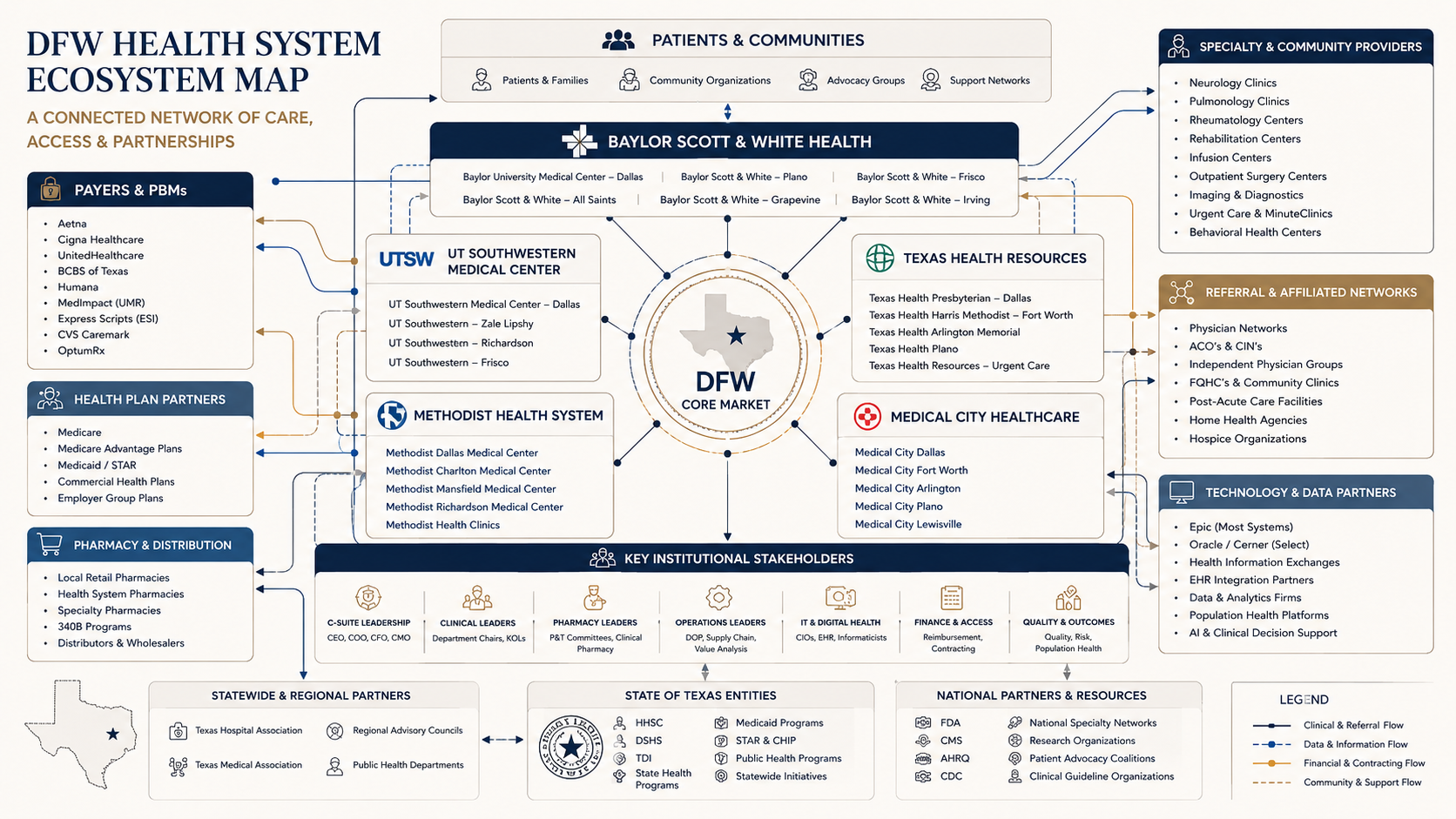
DFW Institutional Access Network
This account architecture maps a regional healthcare ecosystem across integrated delivery networks, academic medical centers, specialty care, payers, PBMs, EHR systems, pharmacy channels, advocacy partners, and cross-functional leadership.
Beyond One City or Facility
The account plan evaluates system reach, referral patterns, hospital service areas, provider density, EHR structure, access pathways, and formulary influence across the broader DFW region.
Access Is Not Linear
Accounts with lower diagnosis volume may still become strategic access drivers based on referral relationships, KOL concentration, formulary access, PBM influence, and pharmacy supply pathways.
Data Sources & Signals
- Epidemiology and claims data
- Treatment patterns and gaps in care
- EHR and disease registry insights
- Competitive market landscape
- Formulary and reimbursement barriers
Account Routing Logic
The system map informs routing strategy by diagnosis volume, referral activity, KOL presence, provider access, formulary openness, payer friction, and implementation feasibility.
Priority Segmentation & Access Feasibility
The account matrix evaluates institutional opportunity across two dimensions: account potential and access feasibility. Account potential considers estimated patient population, revenue opportunity, strategic alignment, and competing therapies. Access feasibility considers formulary openness, payer mix, EHR readiness, IT capacity, PBM activity, and willingness to collaborate.
High Potential / High Access
Highest priority. Accounts with strong patient volume, revenue potential, strategic fit, and feasible access pathways.
High Potential / Medium Access
Strong opportunity with manageable access barriers. Good candidates for targeted formulary, EHR, and payer initiatives.
High Potential / Low Access
Major opportunity with significant barriers. Requires market access strategy, payer navigation, and executive-level engagement.
Medium Potential / High Access
Moderate opportunity with lower friction. Useful for early wins, clinical pathway testing, and adoption proof points.
Medium Potential / Medium Access
Balanced secondary focus. Requires selective resource deployment and milestone-based account development.
Medium Potential / Low Access
Lower priority unless access conditions improve or strategic partnerships create a route into the system.
Low Potential / High Access
Niche or opportunistic engagement. May support referral development or specialty access strategy.
Low Potential / Medium Access
Limited opportunity but may remain relevant for network completeness or regional coverage.
Low Potential / Low Access
Lowest priority. Limited patient volume and poor access feasibility reduce near-term strategic value.
Internal, External & Institutional Decision Pathways
Institutional market access requires coordinated leadership across commercial, clinical, payer, technology, legal, regulatory, and operational functions. The model identifies the stakeholders required to move from account planning to adoption.
Cross-Functional Team
- Senior Leadership
- Market Access
- Medical Affairs / MSL
- HEOR / RWVE
- National Accounts
- Legal & Regulatory
- Health Information Technology
- Sales, Marketing, Policy, Reimbursement
Health System Influence Map
- C-Suite executives
- P&T committee members
- Medical directors and department heads
- Physicians, KOLs, nurses, pharmacists
- DOP, value analysis committee, supply chain
- IT/EHR specialists and CIO stakeholders
- Patients, families, advocacy, payers, PBMs
Formulary Influence Roles
- Chairperson: formulary influence and decision leadership
- Pharmacists: safety, efficacy, cost-effectiveness
- Medical directors: protocols and medication safety
- Nurses: administration and patient care input
- Administrators: budget impact and system policy
Linking Therapy Strategy to Health System Priorities
The account plan aligns product access strategy with system-level KPIs: patient outcomes, quality of care, cost reduction, patient satisfaction, and operational efficiency.
Improve Patient Outcomes
Reduce neurological disability, prevent respiratory failure, improve quality of life, and address unmet need.
Enhance Quality of Care
Standardize treatment pathways, patient selection, medication management, and multidisciplinary coordination.
Reduce System Costs
Decrease hospitalizations, ER utilization, long-term care needs, disability burden, and avoidable care fragmentation.
Improve Operational Flow
Streamline ordering, administration, monitoring, registry tracking, and EHR-enabled treatment workflows.
Market Access Objectives Converted Into Execution Targets
The plan converts strategy into defined goals across formulary inclusion, clinical pathway development, EHR integration, patient access, reimbursement, sales targets, and market share growth.
Preferred Access Target
Formulary tier positioning, preferred status, simplified prior authorization, and avoidance of step-therapy barriers where possible.
Protocol Development
Inpatient NPID management, outpatient infusion, acute exacerbation management, transitions of care, and specialty coordination.
Workflow Enablement
Order sets, decision support tools, alerts, patient registries, data dashboards, and monitoring logic.
Barrier Reduction
Reduce PA denials, improve patient access, maximize reimbursement, and align health system and patient affordability pathways.
Sales & Market Share
Define account quotas, revenue targets, adoption milestones, and account-level performance indicators.
Communication Cadence
Define communication frequency, stakeholder responsibilities, issue escalation, reporting structures, and optimization checkpoints.
30-60-90 Day Execution Framework
The launch plan translates institutional strategy into phased execution: foundation, planning, collaboration, adoption, optimization, and long-term market development.
Foundation, Relationships & Assessment
- Refine 10–15 target accounts and prioritize top 3–5 systems.
- Schedule internal stakeholder meetings and define roles, responsibilities, communication protocols, and reporting structure.
- Research Texas healthcare dynamics, system priorities, decision-making processes, treatment practices, and unmet needs.
- Review account data, market access information, claims trends, historical performance, payer dynamics, and PBM influence.
- Deliver: prioritized account list, initial stakeholder maps, account profiles, internal relationship plan, market access landscape assessment.
Strategic Planning & Collaboration
- Complete detailed account plans with formulary strategy, pathway development, EHR integration, and stakeholder engagement logic.
- Meet with external stakeholders to understand protocols, formulary requirements, KOL opportunities, and adoption barriers.
- Collaborate with MSLs on HCP education, scientific exchange, KOL support, and grand rounds planning.
- Work with Market Access on PA requirements, step therapy, local coverage, payer restrictions, and P&T submission planning.
- Deliver: completed account plans, P&T requirements, education materials, 60-day progress report, early forecasts.
Adoption, Optimization & Long-Term Development
- Implement account plans across P&T, clinical pathways, EHR, patient access, reimbursement, and commercial performance.
- Draft clinical pathway proposals and EHR integration plans with physicians, IT specialists, and system stakeholders.
- Analyze KPIs, identify implementation gaps, refine stakeholder engagement, and resolve access barriers.
- Build long-term relationships, identify market development opportunities, and expand adoption pathways.
- Deliver: 90-day progress report, adjusted account plans, long-term stakeholder strategy, growth opportunity roadmap.
Applicable Across Complex Markets
This architecture is relevant for organizations managing regulated environments, institutional decision-making, access barriers, system integration, and stakeholder complexity.
Life Sciences
Market access, launch readiness, institutional strategy, and field execution planning.
Biotech
Specialty therapy adoption, payer strategy, system engagement, and clinical pathway development.
Healthcare Systems
Operational alignment, EHR workflows, formulary processes, and patient access strategy.
Private Equity Healthcare
Platform continuity, system partnerships, access strategy, and institutional growth planning.
Core Capabilities
A concentrated view of the strategy, access, systems, governance, and institutional alignment capabilities demonstrated throughout this healthcare systems integration case study.
Market Access Strategy
Structured payer, PBM, reimbursement, and formulary navigation strategy across complex healthcare environments.
Healthcare Systems Strategy
Enterprise-level planning across integrated delivery networks, academic systems, specialty care, and institutional operations.
Stakeholder Mapping
Cross-functional alignment among executive leadership, clinical stakeholders, IT teams, payer groups, and operational leadership.
Payer Navigation
Strategic management of reimbursement pathways, access barriers, prior authorization, and formulary positioning.
Institutional Account Planning
Structured account prioritization and expansion strategy across regional healthcare ecosystems.
EHR Integration Strategy
Workflow integration planning supporting ordering logic, monitoring systems, analytics, and operational adoption.
Launch Planning
Multi-phase implementation frameworks translating institutional strategy into executable operational rollout.
Performance Governance
KPI development, reporting cadence, optimization checkpoints, and institutional performance oversight.
Strategic Partnerships
Alignment of providers, payers, systems, leadership teams, and external stakeholders within long-term growth initiatives.
Turning Healthcare Complexity Into Executable Strategy
HIH Advisory supports organizations navigating market access, institutional account strategy, stakeholder alignment, operational launch architecture, and complex systems integration.
Initiate Strategic Inquiry